Made like a coat, not a product.
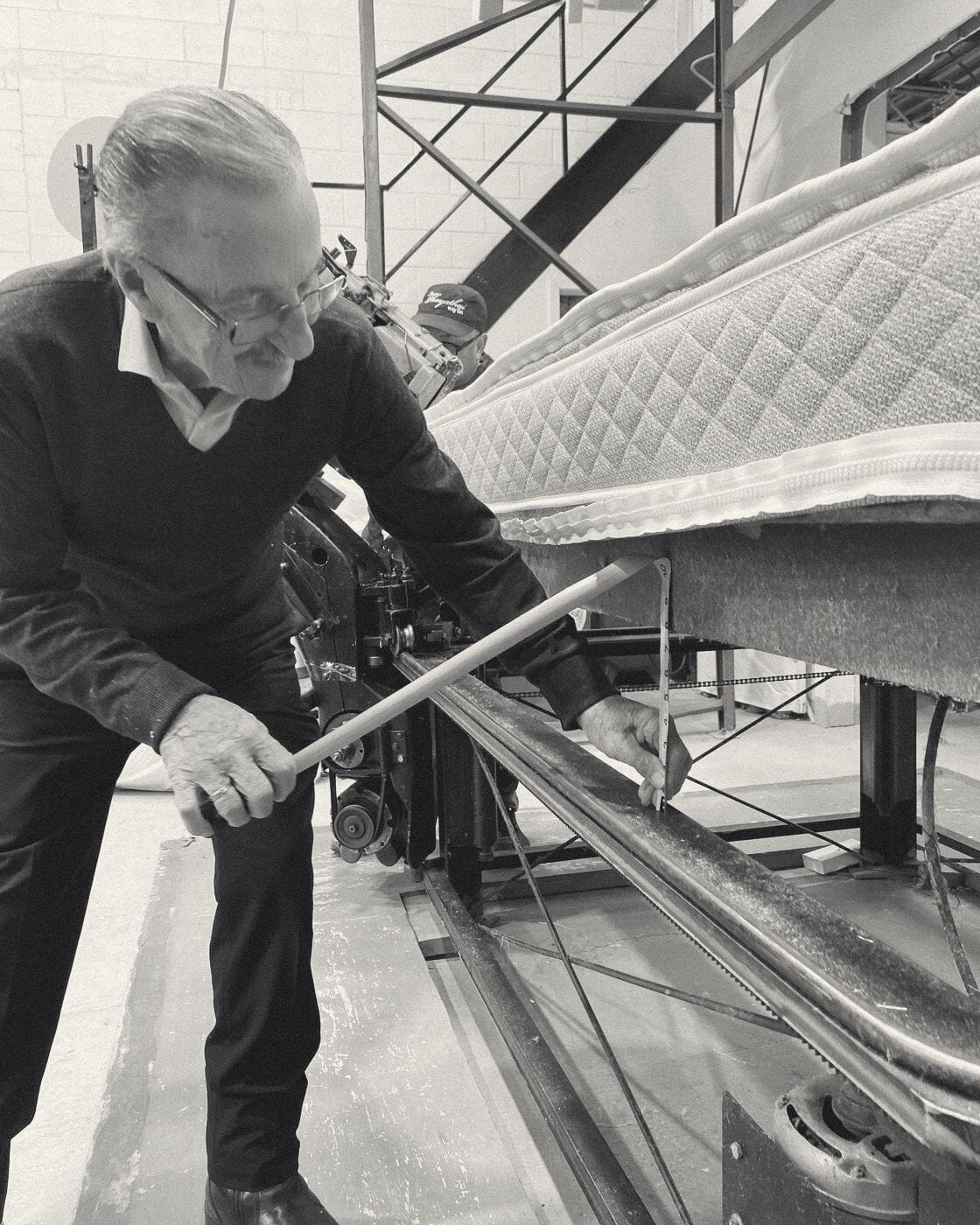
There is a moment, near the end of every Elvaé, when the workshop goes quiet. The layers are composed, the cover is drawn over them, and one person runs the tape edge around the whole bed in a single slow pass. It is the last seam, and the only one everyone will see. Nobody hurries it.
That patience is not a brand story added later. It is how Matelas Personnel has worked since Claude Savoie opened the workshop in 1980, with his wife at his side, on a simple conviction: a mattress should be made the way a tailor makes a coat. Measured, fitted and finished by hand.
Why a tailor, and not a factory
A coat off the rail is cut for an average body. A tailored coat is cut for one, and you feel the difference the moment you put it on: the shoulders sit, the line falls true, nothing pulls. A bed works the same way. The materials matter, but the feel comes from a hundred small decisions about how they are put together, and those decisions are made by hand.
When something is done correctly, it does not need to be redefined.
Six steps at the bench
Every Elvaé passes through the same six stations. None of them is glamorous. All of them are why the bed still looks and feels composed years from now.
Cut, sew, smooth
The quilted panels are cut with a straight knife, guided along the line by eye, never stamped out by a press. Each one is then stitched at the machine, the shears always within reach. At the quilting table, every panel is smoothed flat by hand so the pattern lies true across the whole surface, from the head of the bed to the foot.
Left: the cutting table. Right: at the quilting table, a panel is smoothed by hand before it is sewn.
Measure, close, check
Borders are measured against the bed itself, not against a template, so the cover fits the layers it holds. Then comes the tape edge, run in one steady pass. Last of all, someone checks every line. The standard is simple and a little old-fashioned: nothing leaves the workshop until it has been checked by someone who would sleep on it themselves.
What you will notice at home
A surface that lies flat and even, with the quilting pattern true from edge to edge.
Borders that sit square, so the bed looks tailored on the frame rather than stuffed into its cover.
A feel that stays consistent, because each layer was laid and aligned by hand before the bed was closed.
Some things have changed since 1980. The machines are newer, the materials are better, and the beds now carry a name of their own. The standard has not changed. You can still find Claude on the workshop floor, measuring.
See it for yourself
The best way to understand the bench is to feel what it makes. Every Elvaé can be tried in a showroom near you.

Comments